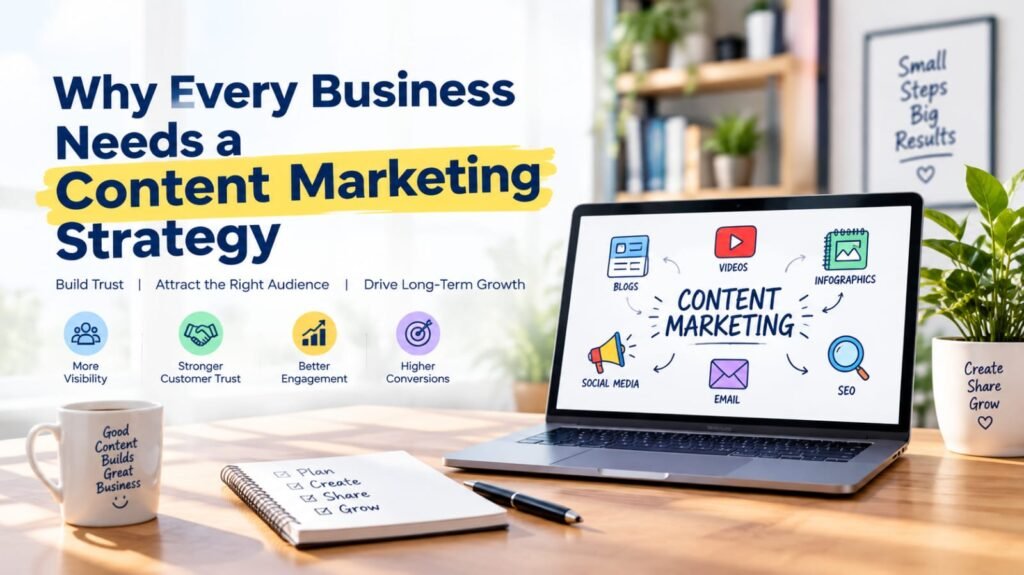
Why Every Business Needs a Content Marketing Strategy
Many businesses create content without having a real strategy.
They post a photo on Monday, a promotional graphic on Wednesday and perhaps a Reel on Friday.
Then they wonder:
“Why isn’t content marketing working?”
The problem may not be the content itself.
It may be the lack of a strategy.
Content marketing is most useful when every piece of content has a purpose and contributes to a larger business objective.
What Is Content Marketing?
Content marketing involves creating and distributing useful information to attract, educate and engage a specific audience.
Content can include:
- Blog articles
- Videos
- Reels
- Social media posts
- Guides
- Case studies
- Newsletters
- Infographics
- Podcasts
The format can change, but the objective remains: provide value to the right audience while supporting business goals.
Start With Your Audience
Before creating content, understand who you’re talking to.
For example, a digital marketer might target:
Small business owners
Their questions could include:
- How can I get more customers?
- Should I use Google Ads?
- How much does SEO cost?
- How can I improve Instagram?
- Why isn’t my website generating leads?
These questions can become content topics.
Create Content Around the Customer Journey
Not everyone is ready to buy immediately.
Some people are discovering a problem.
Others are researching solutions.
Others are comparing service providers.
Your content should support different stages.
Awareness
“Why Your Business Needs Local SEO”
Consideration
“SEO vs Google Ads: Which Should You Choose?”
Decision
“Our SEO Services: Process, Deliverables & Pricing”
This creates a natural path from information to enquiry.
Don’t Create Content Just for Algorithms
A major mistake is writing articles only because a keyword has search volume.
Ask:
“Will this actually help my target customer?”
If the answer is no, reconsider the topic.
Google’s ongoing Search developments increasingly focus on helping users discover useful and original web content, while AI-powered Search is making it easier for users to explore complex questions.
Repurpose Your Content
One good idea can become multiple pieces of content.
For example, write a blog:
“5 Common Google Ads Mistakes.”
Turn it into:
Instagram carousel:
5 Google Ads mistakes
Reel:
“Stop making these 3 Google Ads mistakes.”
LinkedIn post:
A detailed explanation of mistake #1.
Email:
Google Ads checklist.
One topic can therefore support several platforms.
Measure Content Performance
Don’t only count likes.
Depending on your objective, measure:
- Website traffic
- Search impressions
- Engagement
- Leads
- Downloads
- Enquiries
- Email subscribers
- Sales
A blog article that generates 20 qualified enquiries can be more valuable than a social post with thousands of likes.
Build a Content Calendar
A simple calendar can include:
Monday: Educational Reel
Wednesday: Carousel
Friday: Promotional/brand content
Monthly: Long-form blog
The schedule isn’t the most important part.
Consistency and relevance are.
Content Marketing Takes Time
Content marketing is rarely an overnight strategy.
It takes time to build:
- Search visibility
- Audience trust
- Brand recognition
- Authority
- A library of useful content
That’s why businesses should think about content as a long-term asset rather than a collection of individual posts.
Final Thought
A successful content strategy begins with one simple question:
“What does my audience need help with?”
Answer that question consistently, create genuinely useful content, distribute it across the channels where your audience spends time, and connect that content to your business goals.
Content marketing isn’t about creating more content.
It’s about creating the right content for the right people at the right stage of their journey.